
How We Install Fiber
Without Wrecking Your Yard
If you have thought about switching to fiber internet, you may have wondered what the installation actually looks like.
Does the crew dig up your whole yard? Will your landscaping be ruined? Is there going to be a trench running through your grass?
Those are fair questions. Your yard, driveway, garden beds, and outdoor space matter. Nobody wants faster internet if it feels like their property has to be torn apart to get it.
The good news is that fiber installation is designed to be much cleaner and more precise than many people expect. At Beehive Broadband, the goal is not just to bring a fast, reliable connection to your home. It is to do it with as little disruption to your property as possible.
How fiber gets to your home
Before your home can use fiber internet, the fiber line needs a path from Beehive’s mainline neighborhood fiber network to your property. The fiber line that runs from the mainline network to your home is called the drop. This drop line connects your home to Beehive’s neighborhood fiber network so your service can be activated inside the home.
How Beehive protects your yard
Beehive uses a few different installation methods depending on your property, landscaping, home layout, and the existing mainline neighborhood network. The method used from the street to your home can vary, but the goal is always the same: to complete the installation safely, carefully, and with as little disruption as possible.
One installation method is directional boring, also called horizontal directional drilling. This process is used to run fiber underground with minimal impact to the surface. It is typically used for homes that have a lot of gravel, concrete, or hardscape surrounding the property.
Directional boring allows crews to place conduit underground with minimal disturbance to landscaping. This process usually requires two small access holes. One is used for the drilling rods to enter, and the other is used for them to exit so the conduit can be placed properly.
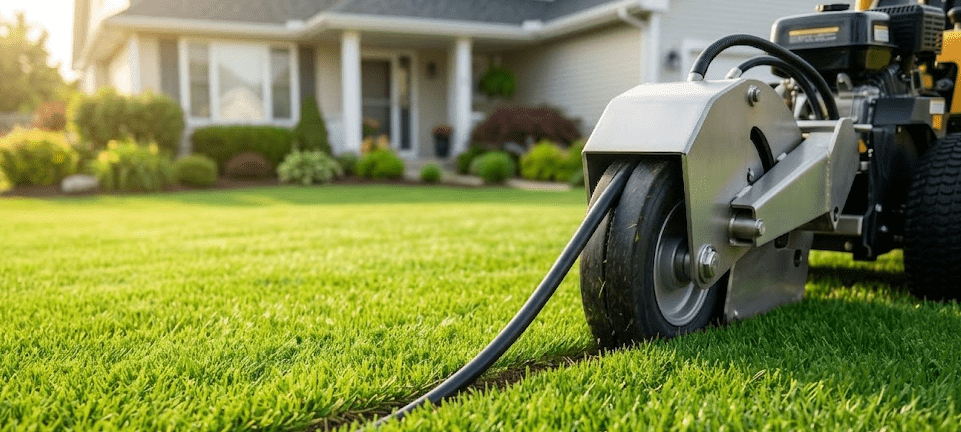
Another method, and one of the most commonly used, is a vibratory plow. This method is minimally invasive and creates a very small cut in the grass, almost like slicing bread. As the machine moves toward the home, it places conduit into the ground. In most cases, customers rarely notice where the line was placed once the work is complete.
At times, our crew may need to use a mini excavator during the installation process. This may happen if the ground is too rocky, frozen, or hard for the vibratory plow to move through. While that may sound intimidating, our crews work carefully to keep your landscaping looking as close to untouched as possible. If any restoration is needed, our team will make sure it is taken care of.
In some communities, aerial installation may be used instead. In those cases, fiber can be carefully attached to poles to deliver service above ground rather than underground. The exact installation method can depend on the area, the property, and the existing network.
Regardless of the installation option our team uses, the goal stays the same: bring a strong fiber connection to your home safely, carefully, and with as little disruption as possible.
What you may see during installation
Even with a low-disruption process, you may still notice some activity around your property.
You may see colored markings or flags placed by utility companies. Please do not remove these flags from your property. They help our team verify that the planned path to your home is the safest option and helps prevent crews from hitting existing underground utilities, such as power, water, or gas lines.
Calling 811, also known as Utah Blue Stakes, is required by law before digging. This helps protect existing utilities, Beehive’s network, and your property.
Did you know that homeowners are also legally required to call 811 and submit a locate request before digging if they are not hand digging? It is free, it is easy, and it is the law.
What happens inside your home
Once the exterior fiber line is in place, the next step is bringing the connection into your home.
A splicing technician or installer will complete the indoor portion of the installation. This usually includes connecting the fiber line from a housing box mounted to the exterior of the home, where the construction crew has run the conduit. The technician will also install equipment such as an Optical Network Terminal, also called an ONT. The ONT converts the fiber signal into internet data your devices can use.
If you are using Beehive’s GigaSpire router or Managed Wi-Fi service, the technician will also help with setup so your home network is ready to go. Please note that Beehive technicians do not connect customer-provided routers or equipment.
Before leaving, the technician tests the network to make sure everything is working the way it should. If you are using Beehive routers or Managed Wi-Fi, this can include checking signal strength, confirming the connection, and running speed tests.
If you are using your own equipment, the technician will check speeds and connectivity while plugged directly into the ONT provided by Beehive.
Why router placement still matters
The fiber line brings the connection to your home, but your router helps distribute it inside your home.
That means placement still matters.
A router hidden in a cabinet, closet, basement, or behind furniture may not give you the best Wi-Fi experience, even with a strong fiber connection coming into the home. Wi-Fi signals must travel through walls, floors, doors, and furniture, and can degrade over distance. The more obstacles between your router and your devices, the more your signal may weaken.
A central, open location can help your router send the signal more evenly throughout the home. For larger homes or homes with tricky layouts, Beehive’s Managed Wi-Fi can also help extend coverage where you need it most.
Ready to get connected?
Getting fiber installed does not have to mean wrecking your yard. With careful planning, low-disruption installation methods, and a team focused on minimizing impact to your property, Beehive makes the process cleaner and simpler than many homeowners expect.
Check if faster speeds are available at your address or contact our team at 844-390-3310 to learn more about getting connected with Beehive Broadband.
Your home deserves a connection that is fast, reliable, and built with care. Beehive makes it happen, start to finish.
SIGN UP
NOW
Areas we serve.
Utah
Bear River, Bothwell, Brigham City, Bullfrog, Caineville, Callao, Cedar Highlands, Centerville, Clearfield, Elwood, Enterprise, Erda, Eskdale, Gandy, Garrison, Gold Hill, Grantsville, Grouse Creek, Howell, Ibapah, Kelton, Kolob, Lake Point, Layton, Lehi, Lindon, Lofgreen, Lucin, Lynn, Marble Hill, Mantua, Midvale, Morgan, Mountain Green, Murray, Notom, Orem, Park City, Park Valley, Partoun, Payson, Perry, Petersen, Penrose, Pleasant Grove, Porterville, Providence, Rush Valley, Sandy Ranch, Skull Valley, SLC(Avenues), Snake Valley, Snowville, Stansbury, Stockton, Terra, Thatcher, Ticaboo, Tooele, Tremonton, Trout Creek, Vernon, Wendover, West Haven, West Point, West Valley City, Woodland Hills
Nevada
Burbank, Deeth, Elko, Goshute, Independence, Marys River, Montello, Moor, Oasis, Pilot Valley, Pleasant Valley, Wells, West Wendover