
Satellite vs. Fiber Internet: What Rural Homes Should Know

Satellite internet has come a long way. For homes in remote corners of Utah where no other option reaches, it has made streaming, video calls and online school possible, and that is a good thing.
It has also become popular enough that many people now wonder if satellite could be their full-time home connection, even when fiber is available on their street.
The short answer: satellite is a great option when nothing else is available, but it is not built to match fiber. The biggest differences are not about download speed. They show up in upload speed, steady response time and reliability when the weather turns.
Here is a plain look at how the two compare and what that means for the things you do online every day.
How Each One Works, in Plain Words
Satellite internet sends your data from a dish on your home up to a satellite in space, then back down to a ground station, and then out to the rest of the internet. Newer satellite systems orbit closer to Earth than older ones, which helps. But those satellites move quickly across the sky, so your dish has to keep switching from one satellite to the next about every 15 seconds. Each switch can cause a brief lag spike.
Fiber internet sends your data as pulses of light through a glass line that runs from the network directly to your home. That line is buried underground or strung on poles. It does not depend on a clear view of the sky, and there is no hand-off between moving satellites.
Think of it this way: satellite is like relaying a message across a moving chain of people. Fiber is like a direct phone line.
Where Satellite Internet Falls Short
For browsing, email and streaming movies, satellite usually does the job. The gap shows up in tasks that need a steady, two-way connection. Here are five everyday examples.
1. Video Calls and Working From Home
Video calls depend on a smooth, steady connection in both directions. On satellite, a hand-off between satellites or a passing storm can cause your video to freeze or your voice to sound robotic for a few seconds. Some work-from-home tools, such as company VPNs and remote desktop software, can also be sensitive to these brief lag spikes.
With fiber, your connection stays steady, so you can focus on the meeting instead of repeating yourself.
2. Uploading Files, Photos and Backups
Upload speed is how fast you send information out from your home. It matters more than most people realize. You use it when you back up photos to the cloud, send large work files, post videos to social media and run home security cameras.
Satellite internet is built mainly for downloading, so upload speeds are much lower than download speeds. Beehive fiber offers symmetrical speeds, which means you get the same speed going up as coming down.
3. Online and Cloud Gaming
Casual and turn-based games generally run fine on satellite. Fast-paced multiplayer games are a different story. They depend on quick, consistent response times. A lag spike at the wrong moment can make your character jump around the screen or miss an action you know you made.
Cloud gaming services, which stream the whole game to your screen as live video, are even more sensitive. Fiber delivers quick, steady response times, which is exactly what these games need.
4. Live Streaming
If anyone in your home streams live on platforms like Twitch or YouTube, a steady upload connection is essential. When upload speed dips, viewers see dropped frames, buffering or a stream that cuts out. Because fiber upload speed matches its download speed, live streams have room to run smoothly.
5. Storms, Snow and Trees
Satellite dishes need a clear view of the sky. Heavy rain can interrupt the signal, heavy snow can weaken it, and a growing tree or a new building in the dish’s line of sight can cause regular dropouts. In a Utah winter, that can mean brushing snow off the dish before you can get back online.
Fiber does not depend on the sky. There is no dish to clear and no branches to trim.
Workarounds Fiber Users Never Think About
Many satellite users rely on extra steps to keep their connection steady. They may add a backup cellular connection to cover hand-off gaps, run cables to avoid Wi-Fi issues or check an app to make sure nothing is blocking the dish. These fixes can help, but fiber users do not need them in the first place.
Fiber vs. Satellite at a Glance
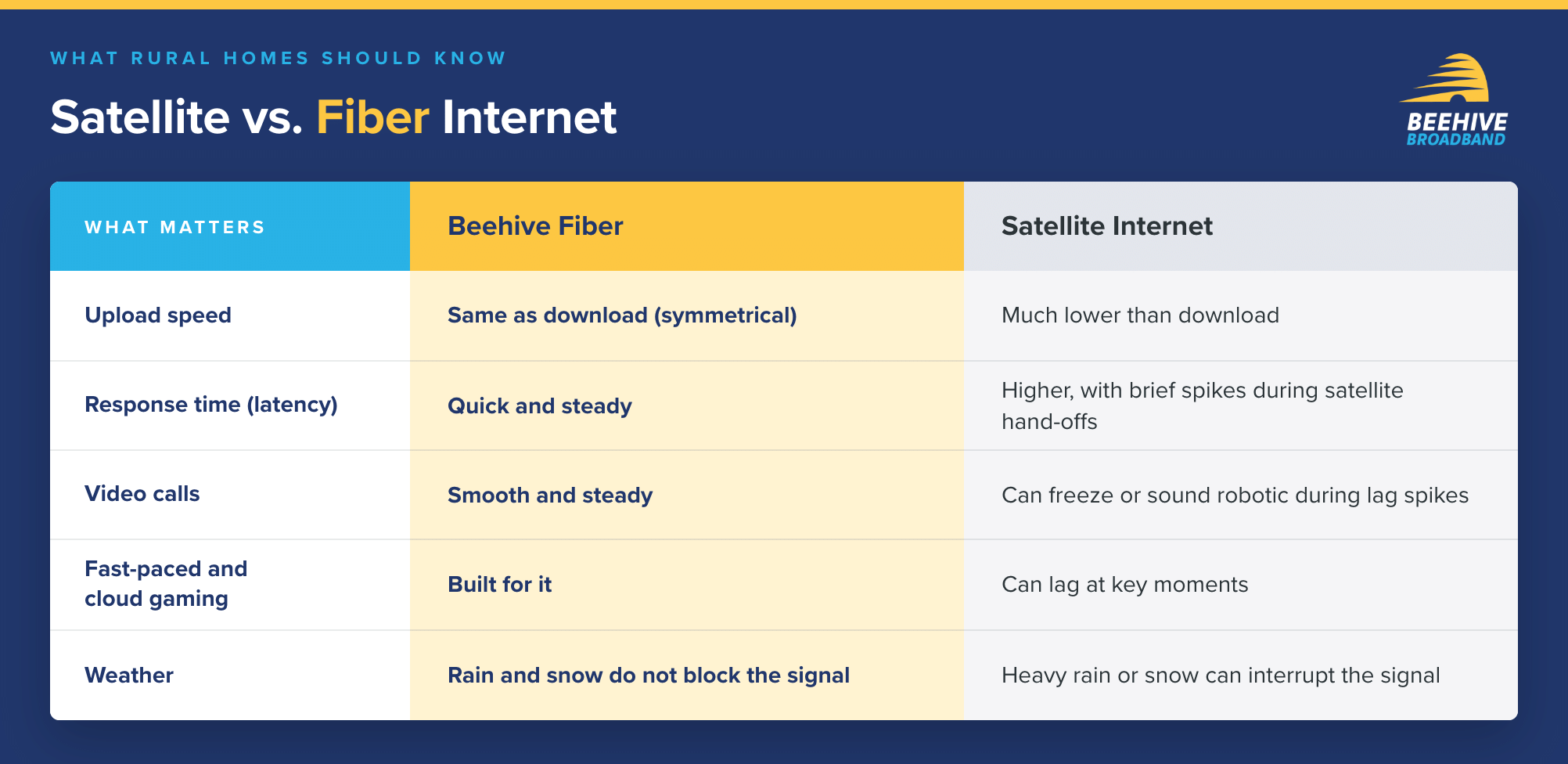
When Satellite Internet Makes Sense
Satellite internet has an important place. For a remote cabin, a ranch far from any network, or a home where no wired option is available yet, it can be the best connection around. Getting people online in places that had no options at all is a real step forward.
But if fiber is available at your address, satellite is usually not the right fit for a full-time home connection. You would be giving up upload speed, steady performance and reliability in bad weather, which are the things that matter most for how families use the internet today.
Think of satellite as a backup, not a replacement. If you work from home or run a business where staying online is critical, satellite can be a reasonable backup connection to keep you going if your main line is ever interrupted. For your everyday connection, fiber is the clear choice.
Why Fiber, and Why Beehive
Fiber is built for the way homes use the internet now: working from home, school video calls, gaming, cloud backups, security cameras and dozens of connected devices running at once. When you compare the two side by side, fiber comes out ahead in every way that matters for a home connection.
With Beehive fiber, you get:
- Symmetrical speeds, so uploads are just as fast as downloads
- Quick, steady response times for calls, gaming and streaming
- A connection that does not depend on the sky, so rain and snow do not block the signal.
- Professional installation by a local team
- Local, 24/7 support from people who live and work in your community
- No data caps
Beehive has served Utah and Eastern Nevada communities for decades, and its fiber network was built to keep rural and suburban homes connected.
See If Fiber Is Available at Your Home
Curious whether Beehive fiber reaches your address? Visit beehive.net to check availability, or give us a buzz at 844-390-3310. Our local team is happy to help you find the right fit for your home.
SIGN UP
NOW
Areas we serve.
Utah
Bear River, Bothwell, Brigham City, Bullfrog, Caineville, Callao, Cedar Highlands, Centerville, Clearfield, Elwood, Enterprise, Erda, Eskdale, Gandy, Garrison, Gold Hill, Grantsville, Grouse Creek, Howell, Ibapah, Kelton, Kolob, Lake Point, Layton, Lehi, Lindon, Lofgreen, Lucin, Lynn, Marble Hill, Mantua, Midvale, Morgan, Mountain Green, Murray, Notom, Orem, Park City, Park Valley, Partoun, Payson, Perry, Petersen, Penrose, Pleasant Grove, Porterville, Providence, Rush Valley, Sandy Ranch, Skull Valley, SLC(Avenues), Snake Valley, Snowville, Stansbury, Stockton, Terra, Thatcher, Ticaboo, Tooele, Tremonton, Trout Creek, Vernon, Wendover, West Haven, West Point, West Valley City, Woodland Hills
Nevada
Burbank, Deeth, Elko, Goshute, Independence, Marys River, Montello, Moor, Oasis, Pilot Valley, Pleasant Valley, Wells, West Wendover